

Garage Door Spring or Cable Problem? How to Tell the Difference
The door is wrong, and you'd like to know what you're dealing with before you call. It's heavy, or crooked, or both. There was a bang, or there wasn't. Is it a spring or a cable?
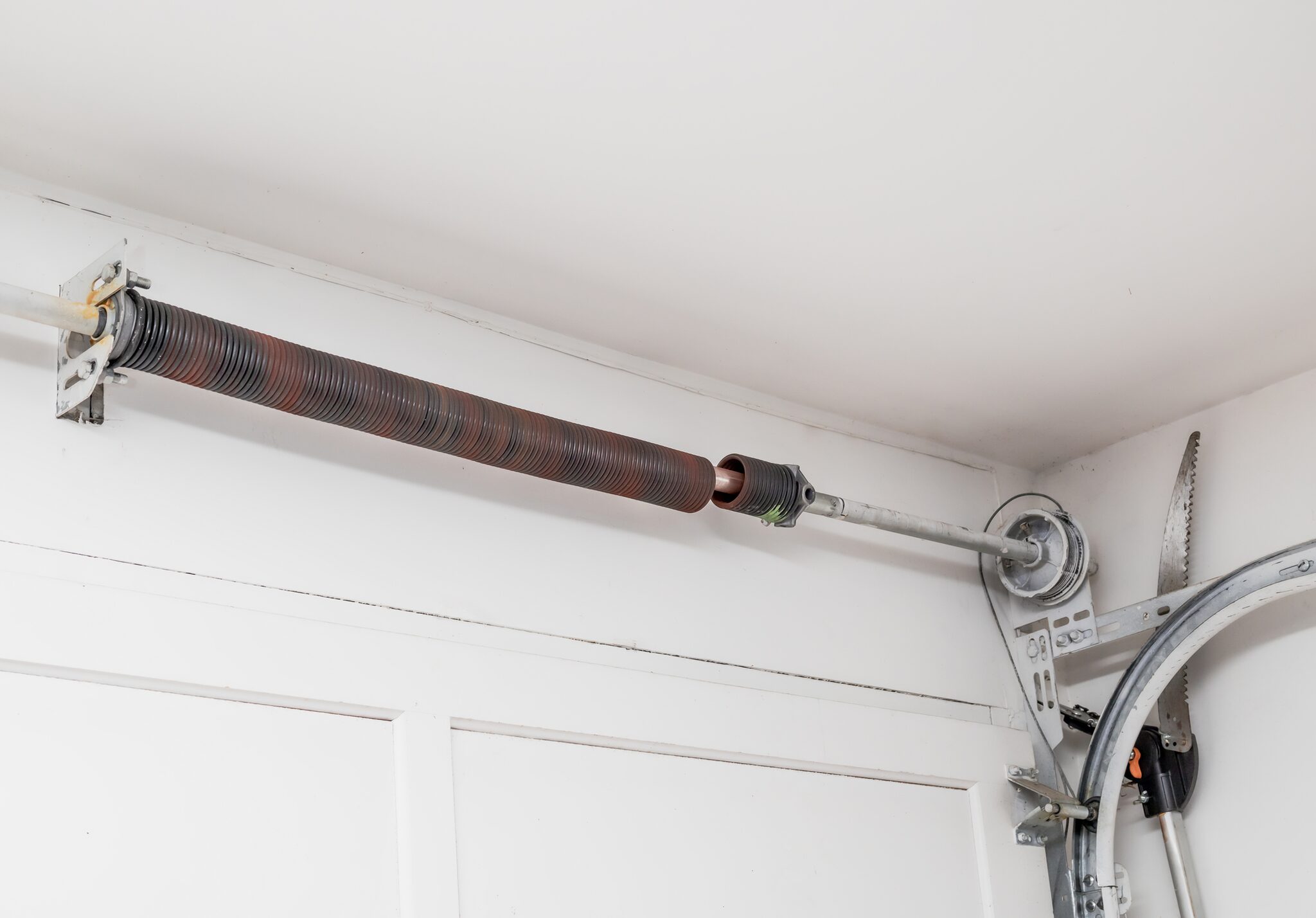
It's a fair question, and from the floor you can usually get most of the way to an answer. You can't always get all the way, because springs and cables are two halves of the same system and one failing often takes the other with it.
Two parts, one job
The springs store the energy that lifts the door. The cables carry it to the door.
On a torsion system, one or two springs sit on a steel shaft above the opening. As the door comes down, the springs wind up. Drums at each end of the shaft hold the lift cables, which run down the sides to brackets at the bottom corners of the door. When the door opens, the springs unwind, turn the shaft, and the drums wind the cables up, lifting both corners evenly.
On an extension system, a spring runs along each horizontal track and stretches as the door closes. The cables run from the bottom corners over pulleys to the springs.
When a spring fails, the door loses its lift. When a cable fails, the door loses its lift on one side. That difference drives most of the symptoms.
Side by side
| What you notice | Points to a spring | Points to a cable |
|---|---|---|
| Loud bang from the garage | Very common | Possible, usually quieter: a twang or snap |
| Door very heavy by hand | Yes | Less so; heavy on one side |
| Door sits level when closed | Usually | Often one side lower |
| Door rises crooked | Sometimes, with two springs and one broken | Very common |
| Gap in the coil above the door | Torsion spring broken | No |
| Extension spring hanging or stretched | Spring failing | No |
| Cable hanging, looped or on the floor | Possible: cables go slack after a spring breaks | Yes |
| Frayed or rusted cable at a bottom corner | No | Cable failing |
| Opener lifts the door a few inches, then stops | Very common | Less common; door more often jams crooked |
| Door drops fast when closing | Yes: no counterbalance | Can drop on one side |
Use the table as a lean, not a verdict. Several of these show up in both.
Signs that point to a spring
- A bang, then a heavy door. Torsion springs usually break with a sharp crack that people hear from inside the house.
- A visible gap. A broken torsion spring shows a clear separation in the coil, often a few inches wide. With two springs, one may look different from the other.
- An opener that strains. The motor runs, the door rises a few inches and stops or reverses, because the opener is trying to lift weight the springs used to carry.
- A door that won't stay put. A door that drops when lifted partway, or comes down faster than normal, has lost counterbalance.
Our article on broken garage door spring signs goes deeper on these.
Signs that point to a cable
- One corner sits higher than the other when the door is closed.
- A cable you can see is wrong: hanging in a loop, unwound beside its drum, lying on the floor, or riding off the drum's grooves.
- Fraying or rust where the cable loops onto the bottom bracket. That's where most cables break, especially in garages where salty slush sits at the threshold all winter.
- The door racks as it moves, with one side leading and the panels twisting in the opening.
If you're already looking at a cable that's off or broken, our guide on what to do when a garage door cable breaks or comes off covers the first steps.
Where they overlap
This is why the answer is sometimes "both."
A broken torsion spring loosens the cables. When the spring lets go, the shaft stops holding the cables taut. The cables go slack and can jump off their drums. So you might see a loose cable and assume a cable failure, when the cable is only a symptom of the broken spring.
A snapped cable shocks the spring system. The sudden release of load on one side can damage the drum or throw the shaft. On extension systems, a cable failure can leave that side's spring out of position.
Worn parts wear out together. Springs and cables do the same number of cycles. If one has failed from age, the other has aged the same amount.
That's why a proper inspection looks at both, whichever one you called about.
Why a door opens crooked
A crooked door is the symptom that causes the most confusion, so it's worth going through the causes one at a time. One side rises faster, or one side stays on the floor while the other lifts.
A loose or slipped cable
The most common cause. A cable that has slackened or come partly off its drum lets that side lag. The door may still move, but it's lifting unevenly.
A broken cable
With one cable gone, that side isn't lifted at all. The door tilts hard, often lifting a foot or more on one side while the other stays down, and it can jam in the tracks.
A damaged or slipped drum
If a drum is cracked or has moved on the shaft, its cable winds differently from the other side. The door rises unevenly even though both cables are intact.
One of two springs broken
On a two-spring torsion system, one spring can break while the other keeps working. The door is heavy and may lift unevenly. On an extension system, one side's spring breaking or stretching leaves that side under-lifted.
A track or roller problem
A bent track, a seized roller, or a roller out of the track can hold one side back while the springs and cables are fine. You'll often see the problem at a specific point in the door's travel. Ice or debris in one track can do the same.
If the rollers have climbed out of the track, that's off-track repair as well as fixing whatever caused it.
What happens if you keep using the opener
With a spring broken, the opener tries to lift a door that's now far too heavy. It strains, strips its drive gear, bends the door arm, or pulls the arm's bracket out of the top section. If the door does get partway up, it has little holding it there.
With a cable gone, the opener pulls a door that's lifting on one side only. The door twists, the rollers climb out of the tracks, and the sections crease. The remaining cable carries everything.
Either way, the damage grows each time you press the button. If the door is heavy or crooked, stop using it, unplug the opener if you can do that without standing under the door, and keep people and cars clear. If the door is open, don't pull the red release cord, because the opener may be what's holding it up.
Sounds, and what they tell you
- A single loud bang, often heard through the house: usually a torsion spring.
- A twang or sharp snap, then a crooked door: often a cable.
- Scraping or grinding at one side as the door moves: a cable riding off its drum, a roller binding, or a track problem.
- The opener grinding or whirring with the door barely moving: the door is too heavy, most likely from a spring. Our article on an opener that runs but the door won't open goes through that case.
Why this isn't a do-it-yourself fix
Both parts are under the full tension of the spring system. The door association DASMA says frayed or worn cables should be replaced only by a trained technician because of the spring tension involved. It also says the bottom brackets the cables attach to are under extreme tension and should be adjusted or loosened only by a technician. Many manufacturers fit tamper-resistant brackets for that reason.
Looking is safe. Touching the springs, drums, cables or bottom brackets isn't.
What a technician checks
When we're called for either problem, we look at the whole lift system:
- Both springs, for breaks, gaps, stretch and matching size.
- Both cables, end to end, for fraying, rust and how they sit on the drums or pulleys.
- The drums and shaft, for cracks, slipping and alignment.
- The bottom brackets, for rust and secure mounting.
- The tracks and rollers, for bends, binding and wear.
- The door's balance by hand, once the system is repaired.
- The opener's force and reversing function.
The repair is then whatever the inspection finds. That might be spring replacement, cable repair, or both.
Common questions
Can a cable break without the spring breaking?
Yes. Cables fail from rust and fraying at the bottom bracket, or from the door landing on something and the cable slipping. The spring may be fine.
If the spring broke, do the cables need replacing?
Not always. If the cables stayed on their drums and aren't frayed, they can often be reset. If they came off, kinked or show wear, replacing them during the spring job is sensible, since the tension is already off.
My door is crooked but I can't see anything wrong. What now?
Stop using it and send a photo of the whole door, both bottom corners and the area above the door. Sometimes the cause is a slipped drum or a track problem that's hard to spot from the floor.
Which is more dangerous?
Both. A broken spring leaves a heavy door with no counterbalance. A broken cable leaves a door that can shift or jam unexpectedly. Treat either one as a reason to stop.
Get it diagnosed
If the door is heavy, crooked, or has a loose cable, stop operating it until the system is inspected. Send us photos of the springs and both bottom corners and we'll tell you what we see. Call 613-265-3667, or start with everyday garage door repair.
Call 613-265-3667 Get a Free Quote