

Garage Door Opener Runs but the Door Won't Open: Where the Power Stops
You press the button. The light comes on, the motor starts, something whirs or clicks up by the ceiling, and the door doesn't move. Or it lifts two inches, shudders, and stops.
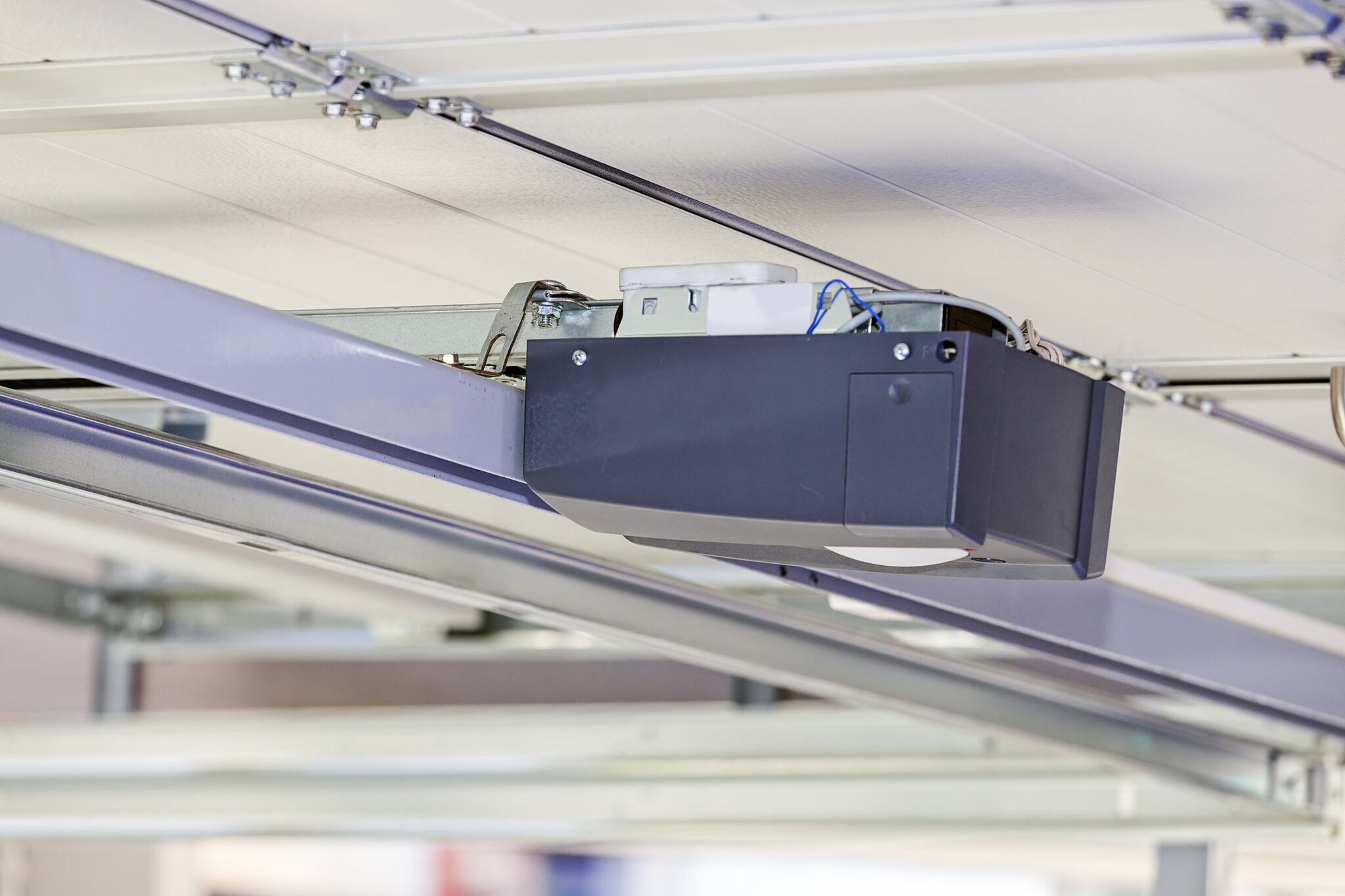
The good news is that the opener has power and is getting the signal, so a whole list of causes is already ruled out: batteries, outlets, lock mode, programming. If you're dealing with a door where nothing happens at all, our article on why a garage door won't open or close covers those first. This one is about what happens after the motor turns.
Follow the power
An opener is a chain of parts, and the power has to get through every one to reach the door.
- The motor spins.
- A drive gear inside the housing turns a sprocket or pulley.
- The sprocket drives the chain, belt or screw along the rail.
- The chain or belt pulls a trolley, a carriage that slides along the rail.
- The trolley hooks onto the door arm, which is bolted to the top section of the door.
- The door rolls up its tracks, with the springs carrying most of its weight.
When the motor runs and the door doesn't, the power stopped somewhere in that chain. Finding where is mostly a matter of watching.
Watch the rail for five seconds
Stand on the floor, off to the side of the door, not under it. Press the wall button once and watch the rail and the trolley. Then stop. One press is enough, and repeated presses can turn a small repair into a bigger one.
| What moves | What stays still | Most likely cause |
|---|---|---|
| Motor, chain or belt, trolley | Door | Trolley released, or the door arm or its bracket broken |
| Motor | Chain or belt, trolley, door | Stripped drive gear or a failed sprocket, pulley or belt |
| Motor, chain, trolley jerks | Door lifts a few inches then stops or reverses | Door too heavy: usually a broken spring |
| Motor strains, chain tight | Door barely moves or not at all | Door binding: a lock, a roller out of the track, ice, or a bent track |
| Motor hums, nothing turns | Everything | Motor or electrical fault inside the opener |
The table narrows it down. The sections below explain each case, and which ones are safe to check yourself.
The trolley moves, the door doesn't
This is the most common version and often the cheapest.
The trolley has been released
The red cord hanging from the trolley disconnects the door from the opener. People pull it during power outages, and sometimes it gets snagged by a ladder, a roof box or a tall vehicle. With the trolley released, the chain drives the carriage along the rail and the door stays where it is.
Reconnecting is designed to be done by the owner, but only with the door fully closed. Reconnecting a partly open door can let it drop. The exact method varies between openers. Some reset by pulling the cord toward the door, others differently. Your manual shows your model, and the model number is on the label on the motor housing. If the door is open and you think it's been released, leave it and call.
The trolley or door arm is broken
On many openers the trolley is partly plastic, and it can crack with age. Pieces of plastic on the floor under the rail are a clue. The door arm can bend, or the bracket that holds it to the top section can pull out of the door, especially on steel doors where the top section wasn't reinforced. In both cases the trolley travels and the door isn't connected to it any more.
The motor runs, but the chain or belt doesn't
If the motor is clearly running and the chain or belt isn't moving, the fault is inside the opener head.
On many chain and belt openers, the main drive gear is nylon or plastic. That's deliberate. The gear is meant to be the weak link, so that it strips before the motor, the board or the door takes the damage. Gears wear with age, and they wear faster when the opener has been lifting a door that's out of balance. A stripped gear often sounds like a fast whir or grind with nothing happening. Sometimes there are plastic shavings on the floor beneath the opener.
Belt drives can also fail when a belt slips off its pulley or the pulley itself wears. Screw-drive and wall-mount openers have their own layouts and their own failure points.
Gear kits exist for many common openers, and on an opener that's otherwise healthy, a gear replacement is usually worth doing. We'd weigh it against the opener's age, how available parts are for your model, and whether the gear failed because the door was heavy. We come back to that last point below.
The door lifts a few inches, then stops
This is the case people most often misread. The opener seems to be the problem because it's the part that's struggling. Usually it isn't.
The springs carry the door's weight. The opener only moves a door that's already balanced. If a spring breaks, the opener is suddenly trying to lift most of the door on its own. It strains, the door rises a few inches, and the opener's force limit stops it or reverses it. That's the opener protecting itself.
Look above the door from the floor. With torsion springs, a broken spring usually shows a clear gap in the coil. With extension springs along the tracks, one may be stretched, hanging or missing. Many people also remember a loud bang from the garage in the last day or two.
If you see any of that, stop pressing the button. Every attempt grinds the drive gear and can bend the door arm. It also risks the door coming down harder than it should. This is a job for broken spring repair, not an opener repair. Our article on broken garage door spring signs shows what to look for.
It's also why a stripped gear and a broken spring so often arrive together. Replacing the gear without fixing the spring means the new gear strips too.
The opener pulls, but the door is stuck
If the chain goes tight and the door hardly moves, something is holding the door.
- A lock is engaged. Some doors have a slide bolt or a lock bar on the inside, and a padlock through the track stops the door cold.
- The door is frozen to the floor. Common after freezing rain or a day of slush dripping off the car.
- A roller has come out of the track, or the track is bent where a car or snowblower hit it.
- The door is racked because one cable has slipped, and it's jammed sideways in the opening.
The lock is the only one of these you should deal with yourself. For the others, the opener pulling harder only bends more metal. A crooked door or a roller out of the track needs a technician to secure it before anything else happens. That kind of work falls under off-track garage door repair.
When the emergency release is the problem
The release itself can fail. A cord that's been cut short or tied up out of the way is a problem the day you need it. A release lever that no longer latches leaves the trolley slipping off the arm under load. Some releases stick after years of dust and cold. If yours won't reconnect after a couple of normal tries with the door fully down, stop forcing it. The trolley may need replacing.
The release also has a safety rule that isn't obvious. If the door is open and you think a spring has broken, don't pull the cord. The opener may be the only thing holding the door up.
Repair the opener or replace it?
Some signs point toward replacing it:
- Parts are gone. On an opener that's twenty-plus years old, replacement gears and boards can be hard to find.
- The gear has stripped more than once and the door has been checked and is balanced.
- The logic board has failed on an older unit.
- There are no safety sensors. An opener without photo eyes near the floor is due for replacement regardless of the current fault.
On a newer opener with a single failed part, repair usually wins. Before either, have the door's balance checked. A new opener on a heavy door fails the same way the old one did. A full opener repair and replacement visit covers both options.
What not to do
- Don't keep pressing the button. Every press on a stripped gear or a heavy door adds damage.
- Don't turn up the force setting to push through. The force limit is part of what makes the door reverse when it hits something. Raising it to make a heavy door move defeats its purpose.
- Don't lift a heavy door by hand to help the opener along.
- Don't stand under a door that's partly open and not moving.
- Don't take the opener cover off while it's plugged in.
Common questions
Why does the opener hum but nothing turns?
A hum with no movement at all usually points to a fault inside the opener, such as a failed start component, a seized motor or a gear that's jammed rather than stripped. It can also mean the door is so stuck the motor can't start turning. Unplug it and have it looked at.
The door opens but won't close. Is that the same problem?
No. A door that opens and then refuses to close, or closes and reverses, is usually the safety sensors. That's covered in our general article on a door that won't open or close.
Can the opener break the springs?
Not directly. Springs fail from age and cycles. But an opener that's been doing extra work on an unbalanced door is a sign the springs were already weak.
Should I get a stronger opener for a heavy door?
No. A heavy door is a balance problem. Fix the springs and a normal opener will move it without strain.
Get it traced properly
If the opener runs but the door won't move, press the button once, watch, and stop. Send us a photo of the rail, the trolley and the springs above the door. We'll tell you whether it's the opener, the springs or the door itself, and give you a flat-rate price before starting. Call 613-265-3667, or start with everyday garage door repair.
Call 613-265-3667 Get a Free Quote