

Broken Garage Door Spring: Warning Signs, What Causes It, and Why DIY Repair Can Be Dangerous
One loud crack from the garage, like something metal let go. Afterwards the door feels as though it's made of concrete, or the opener grinds and lifts it six inches before giving up. That combination almost always means a spring has broken, and the door has lost the part of the system that carries its weight.
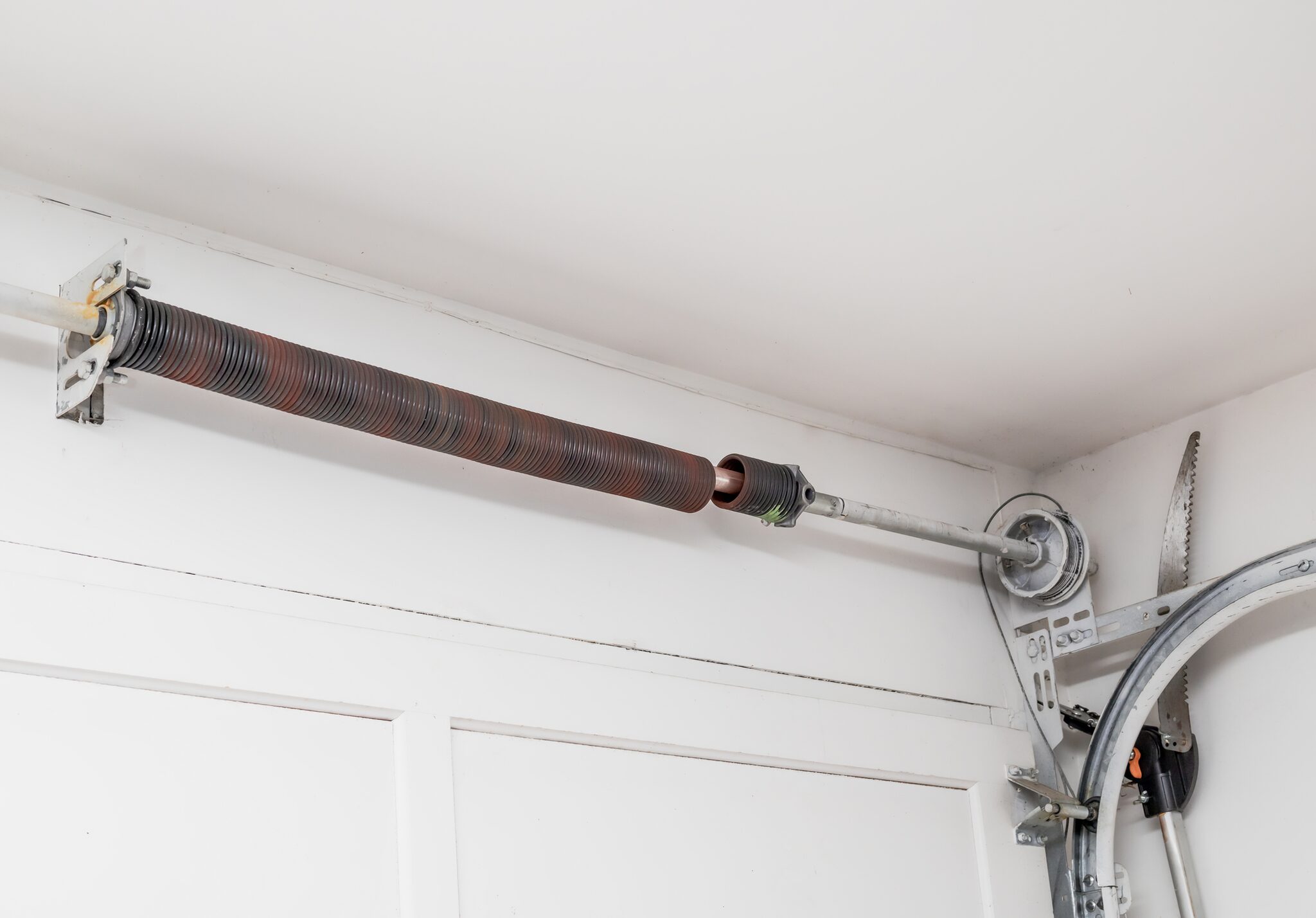
It's an ordinary failure. Springs wear out, and every door eventually needs them replaced. What makes it serious is how much energy those springs hold, and how heavy the door becomes the moment they stop helping.
What the springs actually do
A sectional garage door weighs well over a hundred pounds on most houses, and a lot more if it's a large insulated or wood door. Nobody lifts that with a small motor. The springs store energy as the door comes down and give it back as the door goes up. A well-balanced door feels almost weightless in your hands and stays where you leave it. Clopay, a door manufacturer, describes the springs simply as the counterbalance. DASMA, the industry association, goes further and calls them arguably the most important and most dangerous part of the door.
That's why the opener is a helper, not the strong one. It guides a balanced door along the track. When a spring breaks, the opener suddenly faces most of the door's weight on its own. Sometimes it strains and stops. Sometimes it manages a few inches. Either way its gears take punishment they weren't designed for, and a door that is no longer being held up can come down faster than it should.
Torsion springs and extension springs
Most doors have one of two systems, and they fail differently.
Torsion springs are the more common type. They mount on a shaft above the door opening and twist to store energy as the door lowers. Depending on the door there may be one spring or two, and some systems tuck the spring inside a tube so you can't see it at all. Clopay says torsion springs generally last longer and are considered safer than the alternative, though they cost more.
Extension springs run alongside the horizontal tracks on each side of the door. They stretch as the door closes and shorten as it opens, with pulleys and cables connecting them to the door. They're cheaper and use more parts, and they leave the springs and cables exposed. DASMA says every extension spring should have a safety cable running through it, anchored at both ends, so that a spring that breaks stays contained. If you have extension springs and no safety cable, DASMA's advice is to call a dealer for a safety inspection, not to fit one yourself.
Signs a spring has broken, or is on its way
- A loud bang. Sometimes it's heard from inside the house. Sometimes nobody hears it, and the first sign is a door that won't lift the next morning.
- A very heavy door. If the door is much harder to raise by hand than it used to be, or won't stay where you leave it, the counterbalance isn't working. DASMA's advice for any door that doesn't move smoothly is to treat it as an unsafe condition.
- An opener that strains or hums. The motor runs, the door doesn't move, or moves a few inches and stops. Clopay lists a door that opens only a few inches as a sign of a completely broken spring.
- A gap in a torsion spring. The coil above the door has separated into two pieces, or a new gap has opened between coils. This is often the plainest evidence.
- A stretched, cracked, or broken extension spring. One may hang differently from the other, or the safety cable may be loose or pulled out of position.
- Loose or bunched cables. The lift cables connect the spring system to the bottom corners of the door. When a torsion spring breaks they can go slack and bunch up on their drums.
- A crooked or jerky door. With two springs, a single failure can leave the door lifting unevenly. Clopay also lists jerky movement, and new screeching or grinding, as signs of a failing spring.
- A door that closes too fast. A door that drops quickly instead of coming down under control has lost some or all of its counterbalance.
A caution: springs don't always warn you. A spring can look and sound normal right up to the moment it goes.
What you can look at from a safe distance
Stand on the floor, well clear of the door, with the door closed. Look at the top of the opening. If you have torsion springs, check for a gap, and check whether two springs look alike. If you have extension springs, compare the two sides for stretch, and look for the safety cable and for anything hanging loose. Look at the lift cables for slack or fraying. Look at whether the door sits level.
That's the whole inspection. DASMA's guidance is that spring-loaded parts are looked at, not touched. Don't run the opener to find out whether the door still works. Don't touch the springs, the cones at their ends, or the brackets at the bottom corners of the door. Don't climb a ladder for a closer look, and don't stand under a raised door while you investigate. If the spring is inside a tube and you can't see it, rely on the symptoms instead.
Why springs fail
The cycle count runs out
Every trip up and down flexes the steel. Over thousands of repetitions, metal fatigue does what it does, and the spring eventually cracks. Manufacturers rate springs by cycles, and Clopay says springs are usually rated at 10,000. At four cycles a day, that works out to a bit under seven years. A household that uses the garage as its main entrance may get there sooner, while a door used a couple of times a week could take far longer. Higher-cycle springs exist, and suppliers commonly list them at 25,000 or more.
We won't quote a lifespan in years, because the honest answer is that use and spring type change it. Clopay's guidance is that a door in daily use for seven years or more, with springs that have never been replaced, is a candidate for replacement before it fails.
Rust, moisture, and cold
Springs are bare steel hanging in a garage. Clopay lists rust and cracks as visible signs of damage. In Ottawa the garage air carries road salt and slush off the cars, and freeze-thaw cycles keep moisture cycling through the space. Those are technically reasonable conditions for corrosion, and rust weakens a spring at exactly the places where it flexes most.
Clopay also says spring breaks happen more often in colder months because the spring wire becomes more brittle and weakens in the cold. None of the sources we read measure how much of that is cold and how much is simply that the spring reached the end of its cycles anyway, so we'd treat a cold snap as the trigger more than the cause.
Little maintenance, poor balance
Lubrication reduces friction and noise. Clopay recommends a silicone-based lubricant, not WD-40, applied in a thin layer. DASMA says spring squeaks are normal and can often be treated with a spray-on lubricant made for garage doors before you call anyone.
Balance counts for more. Clopay and DASMA both note that an unbalanced door strains its components. A door that's slightly heavy makes the springs work harder every cycle, and if the opener has been doing the lifting for months, the door is out of balance in a way nobody noticed.
The wrong spring on the door
Springs are sized to a door's weight. Suppliers stress that a replacement should match the original wire size and length for exactly that reason. A spring that's too weak leaves the door heavy, and one that's too strong can make it want to fly up. In both cases something is overworked. Doors also change: an added window section or a heavier replacement panel can shift the weight enough to throw the balance off. If a replacement was sized by guesswork, the door may never have balanced, and the spring works harder than it should for its whole short life.
Should both springs be replaced?
On a door with two springs, DASMA's position is clear: replace both, even if only one has broken. The reasons it gives are that the second spring might fail too, damaging things when it does, and that a matched pair keeps the door working efficiently. Two springs installed on the same day have done the same number of cycles. When one lets go, the other has been carrying an equal share of the wear and now carries the full load until it, too, gives out.
Some suppliers describe it the same way: if one has failed, the other is probably close. If a repair quote only covers one spring, ask why, and ask how old the other is.
Why spring repair hurts people
A torsion spring holds a lot of stored energy, and adjusting it means winding it. That involves specialized winding bars, correct turn counts, and a failure mode where tools slip or a spring releases suddenly. We won't describe the procedure here, and you shouldn't go looking for one. What can be said plainly is this. DASMA states that the hazards of torsion springs are well documented and well known to garage door manufacturers and dealers, the U.S. Consumer Product Safety Commission, and the National Safety Council. Its advice to everyone is to consult a trained door systems technician.
The bottom brackets at the corners of the door are connected to the spring system and are under extreme tension. DASMA says only a trained technician should adjust or loosen them, and many manufacturers now fit tamper-resistant hardware for exactly that reason. Lift cables under load can slip. And the door itself is heavy enough to hurt a person or a vehicle if it drops. Videos make the job look tidy. A repair that goes right for someone else doesn't prove it's safe for you, and a spring that's the wrong size can leave a door out of balance even after a "successful" install.
What to do until it's repaired
- Don't run the opener. It isn't built to lift the door alone.
- Don't try to lift or lower the door by force.
- Keep people, pets and vehicles away from the door.
- If the door is open, don't pull the release cord. With no counterbalance, a released door can fall.
- If the door is closed and a car is inside, call us before you try anything.
- Take a photo of the top of the opening from the floor. It helps us tell what has broken before we arrive.
If the spring has separated or the door suddenly feels extremely heavy, garage door spring repair should be handled carefully — the spring system stores significant tension. A spring that lets go can also drag a lift cable off its drum, and garage door cable repair often goes with that fix. If the door is stuck open or shut right now, call for emergency garage door repair. We repair springs, cables, tracks, rollers and openers across Ottawa — and if you're not sure whether the spring is the culprit, other problems can stop a door from opening or closing too.
If you'd rather talk it through, call Fix My Door Now Ottawa at 613-265-3667 or send us a photo of the door and the spring area.
Need garage door repair today?
We work across Ottawa and the Valley with same-day service, flat-rate pricing, and guaranteed workmanship. Call 613-265-3667 or request a free quote and we will tell you exactly what the fix costs before any work starts.
Call 613-265-3667 Get a Free Quote