A low-energy pedestrian operator makes a swing door accessible without replacing the full entrance. This project shows the operator, controller and door hardware during setup at an Ottawa doorway.
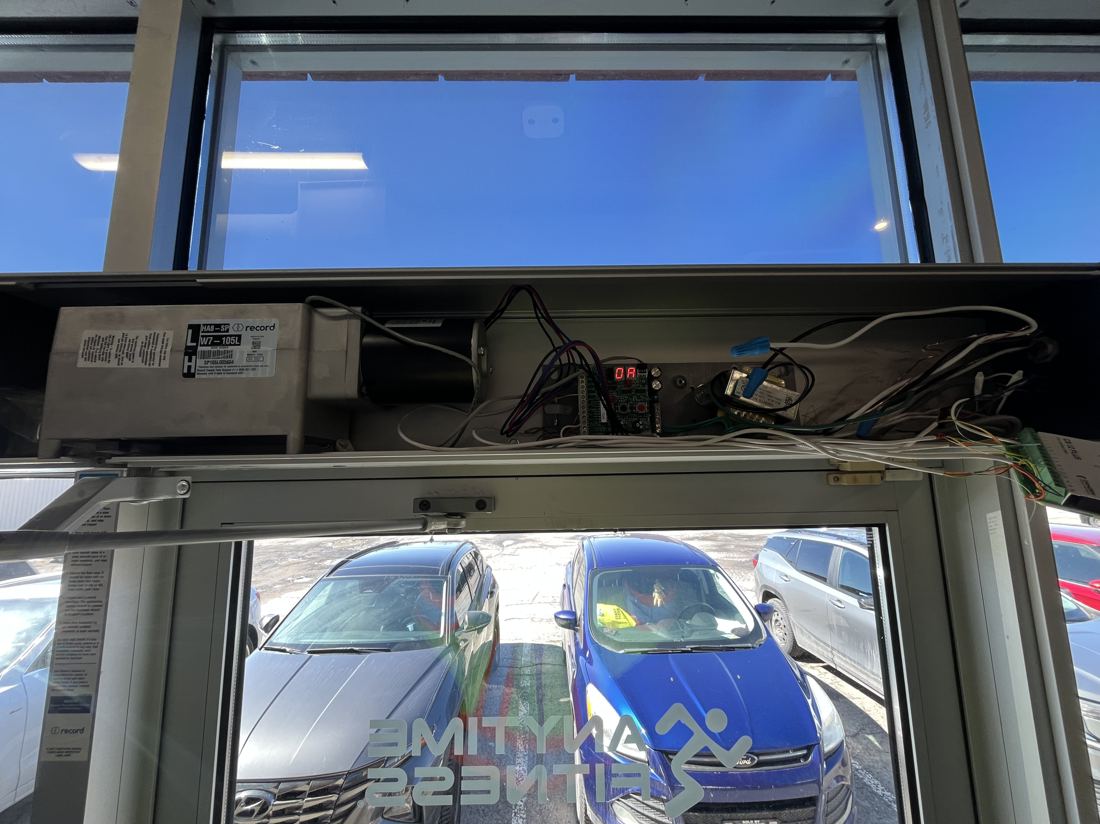
A pedestrian door operator is designed for people who need a swing door to open without pulling or pushing the leaf by hand. It is common at clinics, offices, apartment lobbies, washrooms, vestibules, community buildings and retail entrances across Ottawa. Unlike a high-speed automatic sliding entrance, a low-energy operator moves the door slowly and gently. That slower cycle is what makes it practical for many existing swing doors, but it still has to be installed and adjusted correctly to be safe.
The photo shows the operator and wiring during installation. At this stage, the cover is still open because the controller, power, actuator wiring and setup are being checked. Closing the cover is the easy part. The important part is verifying that the operator responds to the push plate or wave switch, opens the door far enough for clear passage, holds open long enough for a slower user, and closes with controlled force so the door does not slam.
Before installing a pedestrian operator, we inspect the door and frame. If the hinges are worn, the closer is fighting the operator, the latch is misaligned, or the frame is loose, the powered unit will struggle. We correct those issues first. The operator can only perform as well as the door it is moving. For exterior Ottawa entrances, we also look at threshold drag, weatherstripping pressure and wind exposure, because all of those can make a low-energy operator seem weak when the real issue is friction or binding.
Activation is planned around real users. Push plates need to be reachable from a wheelchair and placed far enough from the swing path that the user is not forced to stand where the door opens. Touchless wave switches need the right sensing range so they are convenient without triggering every time someone passes nearby. For vestibules, the inside and outside actuators may need sequencing so the door does not open into someone already in the space.
This work links directly to our pedestrian operator repair and installation Ottawa service. We install and repair low-energy operators, push plates, wireless transmitters, wave switches, arms, controllers and power supplies. If your building needs a full automatic entrance instead, automatic door installation page. If the operator needs to release from a card reader, buzzer or fob system, our access control installation service covers that integration.
After installation, we commission the operator by cycling it repeatedly and adjusting the speed, force and hold-open timing. We confirm that the door can still be used manually, that the latch seats cleanly, and that the operator does not force the lock or strike. On accessible entrances, comfort matters. A door that technically opens but rushes someone through the opening is not a good installation.
The goal is a barrier-free door that works quietly every day. Staff should not have to explain it, reset it or prop it open. Users should press or wave, wait a moment, pass through and trust that the door is staying open long enough for them. That is what a properly installed pedestrian operator provides.
Maintenance planning is part of a good accessible operator installation. Push plates loosen, wireless batteries die, arms need tightening and timing can drift as the operator wears. We explain what a normal cycle should look and sound like so staff can spot problems early. A slow response, grinding noise, short hold-open time or door that no longer latches cleanly should be checked before the entrance becomes unusable. For Ottawa property managers, that small amount of attention keeps accessible routes dependable for tenants, patients, visitors and staff.
Call for low-energy operator installation or repair across Ottawa and the Ottawa Valley.
Common questions about this project and the service behind it.