

How to Secure a Sliding Patio Door Against Break-Ins
A sliding patio door is often the easiest way into a house. It usually faces the back yard, out of sight of the street, and the only thing holding it shut is a small hook latch at the edge of the panel. The good news is that a sliding door is also one of the cheapest doors to make much harder to open. Here is what works, from the simplest fix to the strongest.
Why sliding doors are a target
A sliding door can be beaten in two ways. The first is prying: a screwdriver or bar at the latch side can bend a worn hook latch or pull the keeper out of a soft frame. The second is lifting: many older sliders can be lifted up and out of their track when the panel is closed, because there is nothing stopping the panel from rising. A door whose rollers have worn down sits low in the track, which makes both problems worse because the latch no longer catches properly.
1. Make sure the latch actually catches
Before adding anything, close the door and lock it, then try to slide it open from inside. If it moves, rattles or the latch only just catches, fix that first. The usual causes are worn rollers that let the panel drop, a bent latch, or a keeper that has worked loose. Adjusting or replacing the rollers lifts the panel back up so the latch lines up again, and a worn latch can be replaced; see sliding door lock repair.
2. A security bar
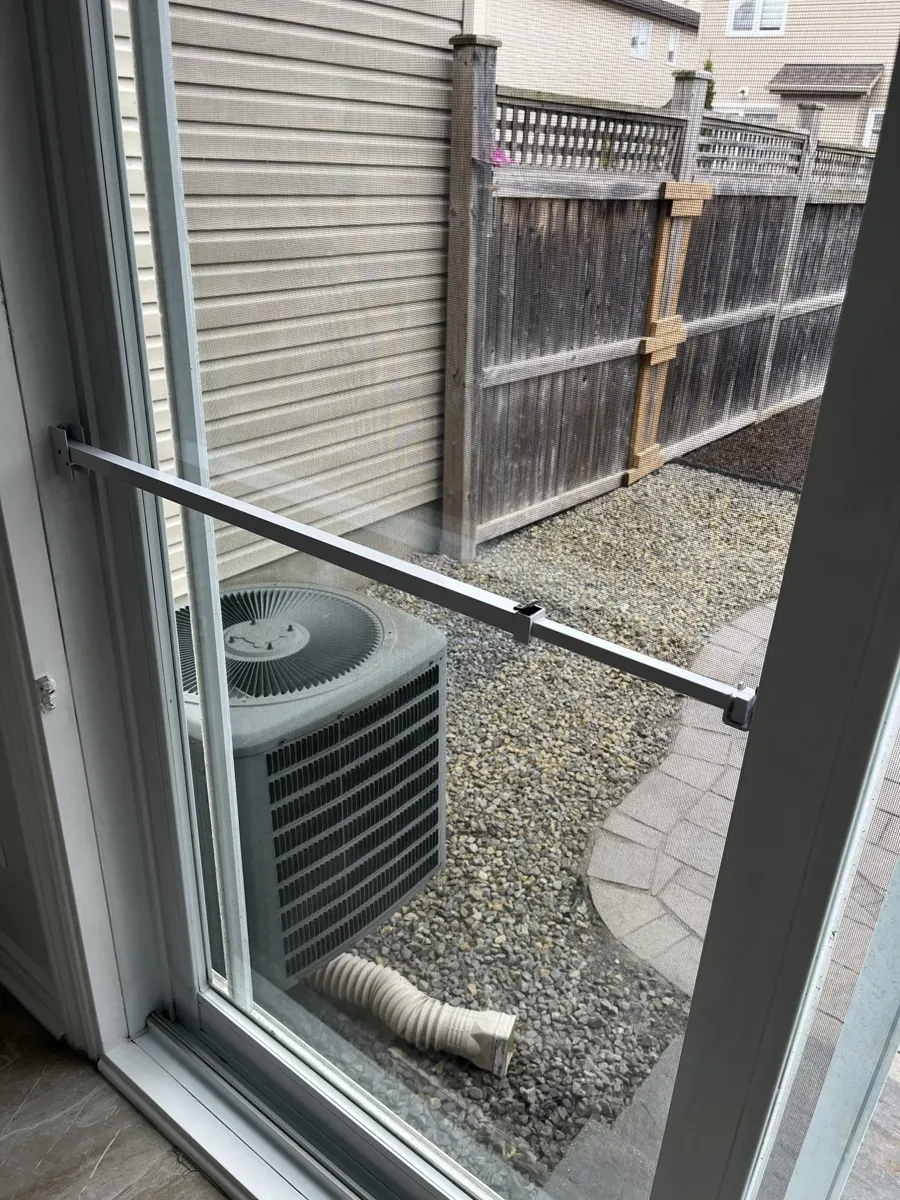
A security bar braces the sliding panel against the frame so the door cannot move even if the latch fails. The type we install mounts at mid-height: it is hinged on a bracket on one side and drops into a cradle on the other. Mid-height matters because that is where someone forcing the door has the most leverage, and it is visible from outside, which on its own puts people off.
The swing-down design is also easy to live with. You lift it up against the frame to open the door and drop it down at night, so there is nothing to take off and lose. See our Stittsville security bar project for photos and a short video of one in use.
3. A dowel in the track
A wooden dowel or a cut broom handle laid in the bottom track stops the panel sliding. It costs almost nothing and is far better than nothing, especially as a stopgap. Its limits: it only braces the bottom of the panel, it does nothing against lifting, and it is easy to forget to put back after the door has been used.
4. Anti-lift blocks
Anti-lift blocks or screws fitted in the top track leave just enough clearance for the panel to slide but not enough to lift it off the track. They are small, invisible from outside, and stop the lift-out method completely. On many sliders they are a quick add-on to a security bar or a new lock.
5. A secondary lock
A foot lock or pin lock at the bottom of the panel locks the door in a second place, independent of the latch. Some keyed patio locks can be used from outside as well, which helps if the patio door is the one you come and go through. See patio door lock repair.
6. The glass
If someone is willing to break the glass, no lock will stop them. Security film on the inside of the glass holds the pieces together and slows a break-in down; laminated glass does the same job built into the unit. See window security film.
Other simple ways to protect the house
- Front and side doors: most forced entries split the frame at the strike. A reinforced strike plate with long screws into the framing is the most useful upgrade on any hinged exterior door; see how to secure your front door.
- Deadbolts: a good deadbolt that throws its full length into a reinforced strike. Our sister company Can-Lock Security installs and upgrades them; see deadbolt installation in Ottawa.
- The door from the garage: often left with only a knob lock. It deserves a deadbolt too.
- Lighting: a motion light over the patio and side doors. Most break-ins happen where nobody can see.
- Door and window sensors: inexpensive contacts on the patio door and basement windows, connected to an alarm or a phone app, tell you when they are opened.
- Keys: if you do not know who still has keys, rekey the locks; see rekeying in Ottawa.
What we would do on a typical patio door
For most Ottawa homes, the practical combination is: adjust or replace the rollers so the latch catches, fit anti-lift blocks, and install a swing-down security bar. That covers prying, lifting and a failed latch, and it is usually a single visit. If the door has already been forced, see our guide to door repair after a break-in.
Want your patio door more secure?
Send us a photo of the door from inside and we will tell you what it needs: a security bar, anti-lift blocks, a new latch or roller work. We work across Ottawa and the Valley with a written parts and labour warranty. Call to confirm the earliest appointment.
Call 613-265-3667 Get a Free Quote